
The AI-First Marketer: Why the Future Belongs to Those Who Learn to Work With Artificial Intelligence
The New Era of Marketing Efficiency Has Arrived
Imagine a marketing department where campaigns launch without endless email chains, performance reports update automatically, and teams spend more time developing creative strategies than managing spreadsheets. What once seemed like an ambitious vision is becoming an increasingly practical reality through artificial intelligence.
Marketing has always demanded a balance between creativity, strategy, and execution. However, growing customer expectations, expanding digital channels, and increasing pressure to demonstrate measurable results have made traditional marketing operations more complicated than ever. Teams often get bogged down in repetitive tasks that eat up valuable time without directly driving growth.
In her book AI Unleashed! The CMO’s Strategy for Smarter Marketing with AI, Shannon Diem explores how artificial intelligence is transforming this operational landscape. Drawing on her extensive marketing leadership experience, Diem shows that AI offers more than faster task completion: the chance to build intelligent, coordinated marketing systems that support sustainable business growth.
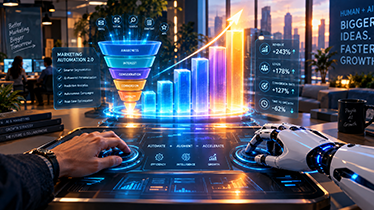
This transformation represents the arrival of Marketing Automation 2.0, where technology doesn’t simply follow instructions but helps organizations make smarter decisions, improve collaboration, and operate with greater precision.
Moving Beyond Traditional Marketing Automation
Traditional marketing automation introduced businesses to scheduled emails, predefined customer journeys, and rule-based workflows. These capabilities simplified everyday operations, but they also had limitations. Most systems relied on employees to manually set rules, update information, and respond when circumstances changed.
AI-powered automation introduces a different approach.
Instead of executing the same predefined sequence regardless of results, intelligent systems can analyze customer interactions, recognize emerging patterns, and recommend adjustments based on changing conditions. This creates marketing processes that better reflect actual customer behavior.
For example, a conventional email campaign might send the same follow-up message to everyone who downloads a resource. An AI-enhanced workflow can assess engagement patterns, identify promising prospects, and recommend more relevant communications for different audience segments.
Shannon Diem emphasizes that marketing operations should evolve beyond administrative support into an essential driver of organizational performance. When automation becomes part of strategic decision-making, marketing departments gain the flexibility to respond to opportunities without constantly rebuilding their processes.
The objective is no longer simply completing more tasks. It is ensuring that every activity contributes meaningfully to business objectives.
Automating Campaign Workflows From Planning to Execution
A successful marketing campaign involves numerous interconnected activities. Creative briefs must be prepared, content requires approval, audiences need segmentation, and multiple channels must be coordinated before launch.
Managing these responsibilities manually creates delays, especially when multiple campaigns run simultaneously.
AI helps simplify this complexity by connecting individual tasks within structured workflows. A campaign brief can initiate assignments, automated notifications can alert stakeholders when approvals are required, and intelligent systems can identify potential delays before deadlines are missed.
Content operations also benefit significantly. AI can help organize digital assets, develop initial copy variations, check brand consistency, and prepare materials for different distribution channels.
In AI Unleashed!, Diem shares an experience involving nine active campaigns managed across six different tools. By introducing AI-assisted workflow triggers, connected reporting systems, and automated identification of project blockers, her team reduced campaign execution cycles by 48%.
This example shows how operational improvements can affect an entire department. Removing unnecessary coordination gives marketers additional capacity to refine campaign messaging, evaluate audience responses, and pursue opportunities that might otherwise be overlooked.
Effective automation does not eliminate professional judgment. It creates an organized execution environment where human expertise can deliver greater value.
Turning Marketing Reporting Into Intelligent Decision-Making
Marketing departments generate enormous amounts of information. Website traffic, advertising performance, customer engagement, conversion rates, and campaign spending all contribute to understanding business results.
The challenge is transforming these disconnected figures into meaningful decisions.
Traditional reporting often requires analysts to collect information from multiple platforms, organize spreadsheets, prepare dashboards, and explain performance changes. By the time reports reach decision-makers, valuable opportunities may already have passed.
AI-powered analytics makes reporting faster and more actionable.
Intelligent systems can consolidate performance information, identify unusual changes, highlight emerging trends, and generate understandable summaries. Instead of merely showing declining engagement, an AI-supported dashboard can help teams investigate which audience segments or campaign elements need attention.
Predictive capabilities add another dimension by helping marketers evaluate potential outcomes before committing additional resources.
Diem highlights the importance of using AI to support forecasting, campaign optimization, and budget allocation. Marketing leaders can explore scenarios, compare investments, and make decisions based on available evidence.
As a result, reporting becomes an ongoing decision-making process rather than a retrospective administrative task. Teams gain the insight necessary to adjust strategies while campaigns remain active.
Connecting Marketing, Sales, and Operations Through AI
One of the most persistent obstacles to marketing performance is departmental separation.
Marketing teams focus on generating interest, sales professionals focus on converting prospects, and operations departments manage the systems that support both. When information remains isolated, misunderstandings emerge, and promising opportunities can disappear between departments.
AI creates opportunities for stronger coordination by improving how information moves across organizational boundaries.
Consider lead management. Instead of relying solely on basic scoring rules or manual assignments, AI-supported systems can evaluate behavioral data and customer characteristics to identify prospects with stronger purchase intent.
These insights can support automated lead routing, helping sales representatives prioritize relevant conversations. Meanwhile, marketing teams get clearer insight into which activities drive qualified opportunities.
Operations professionals benefit from more consistent records, transparent workflows, and better visibility into departmental responsibilities.
Shannon Diem explains that marketing operations increasingly connects sales, product, customer success, and finance. This broader coordination allows organizations to align customer communications, manage resources, and understand how marketing contributes to revenue.
However, technology alone cannot establish meaningful collaboration. Departments must agree on shared objectives, establish clear responsibilities, and communicate openly about how automated decisions influence their work.
With these foundations in place, AI can strengthen cooperation instead of adding complexity.
Building Scalable Marketing Systems Without Increasing Complexity
Growth creates an unusual challenge for marketing teams. As businesses expand, campaign volumes increase, audiences diversify, and customer journeys require more coordination.
Without efficient systems, expansion can produce additional administrative work, higher operating costs, and inconsistent customer experiences.
Marketing Automation 2.0 offers a more sustainable alternative.
By establishing connected workflows, standardized processes, and reusable automation frameworks, organizations can manage increasing workloads without requiring proportional increases in manual effort.
An automated customer onboarding journey, for instance, can support a growing customer base while maintaining timely communications. Similarly, centralized campaign management can coordinate multiple initiatives without creating separate administrative structures for every new project.
Scalability also depends on reliable information. AI systems require accurate customer records, consistent data practices, and appropriate oversight to deliver useful recommendations.
Diem emphasizes starting with manageable improvements rather than attempting a complete technological transformation immediately.
Organizations can identify one repetitive process, set measurable performance goals, test automation, and gradually expand successful practices.
This approach supports sustainable progress while helping employees build confidence in new systems.
Why Human Expertise Remains the Competitive Advantage
Despite its operational capabilities, artificial intelligence cannot independently replace the strategic understanding, creativity, and accountability required for effective marketing leadership.
Automated recommendations still require evaluation. Generated content needs careful review, customer information requires responsible handling, and key business decisions benefit from experienced human judgment.
The strongest marketing teams therefore treat AI as a collaborative resource rather than an independent decision-maker.
In AI Unleashed!, Shannon Diem consistently reinforces the importance of empowering employees through technology. Her approach focuses on removing unnecessary work so professionals can concentrate on responsibilities that require insight, innovation, and relationship-building.
Successful adoption also depends on organizational culture. Leaders must provide training, encourage experimentation, establish appropriate safeguards, and demonstrate practical benefits employees can recognize.
When people understand how automation supports their responsibilities, technology becomes a shared advantage instead of a source of uncertainty.
The Future Belongs to Intelligent Marketing Operations
Marketing Automation 2.0 represents a fundamental change in how businesses organize and execute their marketing activities.
Campaign workflows become more coordinated, analytics becomes more actionable, departmental collaboration improves, and operational systems become better equipped to support expansion.
The real advantage isn’t automation itself, but the organizational capability it creates.
Shannon Diem’s AI Unleashed! The CMO’s Strategy for Smarter Marketing with AI offers a practical perspective on this evolution, showing how thoughtful AI adoption can turn marketing operations from a collection of disconnected responsibilities into an integrated engine for business growth.
For marketing leaders, the opportunity is clear: build systems that reduce operational friction while strengthening the expertise of the people behind them.
The next generation of high-performance marketing teams will not be defined by how many tasks they automate, but by how intelligently they turn efficiency into meaningful results.